2025年2月23日星期日

The forecast and trend outlook of the global makeup brush market in 2025

 Makeup brush manufacturers should not only focus on makeup brush production, but also fully understand market trend which is the key to ensuring that product development and strategic direction match market demand. Manufacturers need to dynamically monitor industry reports, consumer behavior data and policy changes to timely adjust R&D, production and marketing strategies. For example, combining environmentally friendly material research and development with social media promotion can simultaneously meet policy compliance and young consumer preferences.

 
Based on the analysis of industry trends (such as Euromonitor, Statista, Grand View Research, etc.), changes in consumer behavior and technological innovation, the following is the forecast and trend outlook of the global makeup brush market in 2025;
 
Global makeup brush market in 2023 and 2024:
 

#Country2023 sales2024 salesCore drivers
1ChinaAbout $1.2 billionAbout $1.5 billionThe world's largest beauty market, e-commerce live streaming drives demand,domestically produced affordable makeup brushes account for 70%
2USAAbout $950 millionAbout $1.1 billionDominated by high-end brands, high demand for professional makeup artists,Rising demand for clean beauty
3JapanAbout $620 millionAbout $680 millionJapanese exquisite makeup culture, leading makeup brush craftsmanship,antibacterial brushes and nano-coating technology innovation
4South KoreaAbout $480 millionAbout $520 millionK-Beauty trend, strong demand for portable makeup brushes,Air cushion powder puff + brush two-in-one product is hot selling
5GermanyAbout $350 millionAbout $380 millionThe largest market in Europe, preference for environmentally friendly natural materials
6FranceAbout $270 millionAbout $290 millionA concentration of luxury beauty brands
7UKAbout $230 millionAbout $240 millionFast fashion beauty and professional makeup brushes are equally important
8IndiaAbout $180 millionAbout $450 millionEmerging market, rapid growth in demand for affordable brushes
 

1. Market size and growth forecast in 2025

Overall size:
It is expected that the global makeup brush market sales will exceed US$11-12 billion, with an annual growth rate of 7-9% (Asia-Pacific and Latin America are the main growth engines).

 
Driving factors:
 
  1. The expansion of the middle class in emerging markets (India, Southeast Asia, Brazil);
  2. The rise of the male beauty market (increasing demand for men's foundation brushes and contouring brushes);
  3. The popularity of beauty tutorials (YouTube and TikTok drive demand for professional tools).
 
Regional growth highlights:
  

CountryForecast GrowthGrowth Core Reasons
IndiaAnnual growth rate 30%+Affordable beauty products boom, e-commerce penetration rate increases
Southeast AsiaVietnam, Indonesia market growth rate 20-25%Generation Z demographic dividend, rise of local brands
Middle EastSaudi Arabia, UAE growth rate 15%Luxury beauty products consumption, holiday gift demand
 

2. Makeup brush types and technology innovation forecast

Type Share Trends in 2025
  1. Foundation brushes, 25%↓ (competition for air cushion and sponge substitution intensifies)
  2. Eyeshadow brushes, 26%↑ (multi-color eye makeup and artistic makeup are popular)
  3. Multi-function brushes, 12%↑ (emerging markets are dominated by "one brush for multiple uses")
  4. Sustainable brushes, 20%↑ (EU environmental regulations force transformation)
  5. Smart electric brushes, New category explosion (estimated to account for 5%)
 
Technological innovation


Smart makeup brushes:
  1. Built-in AI chip (adjusts foundation dosage according to skin quality, such as the concept product of Revlon);
  2. Warm brush head (improves skin care product absorption, Japan Shiseido has applied for a patent).
 
Environmentally friendly materials:
  1. Plant-based synthetic hair (corn fiber, mushroom leather brush handle);
  2. 100% biodegradable packaging (led by European brands).
 
Customized services:
  1. 3D printing brush head (adapts to personal facial contours, Chinese start-ups are testing the waters);
  2. DIY selection of bristle hardness/density (online customization platforms are emerging).
 
3. Consumer behavior and market differentiation

High-end vs. affordable market:
  1. Europe, America, Japan and South Korea: High-end brushes (unit price $50+) account for more than 40%, with significant premiums on materials and design;
  2. Emerging markets: $5-10 affordable brushes dominate (supply chain advantages in Yiwu China and India).
 
Channel changes:
  1. Live e-commerce: China's "Tiktok, Kuaishou and Taobao" account for more than 60% of the global online sales of makeup brushes;
  2. Subscription services: The "monthly order of brush boxes" model is growing in Europe and the United States (such as Ipsy and Birchbox).
 
Health needs:
  1. Antibacterial bristles (silver ion coating) become standard;
  2. Demand for hypoallergenic materials (for sensitive skin) increased by 20%.
 
 
4. Risks and Challenges

Supply Chain Pressure:
  1. Rising prices of synthetic fibers (fluctuations in petroleum derivatives);
  2. Animal hair brushes are boycotted by animal protection organizations (European and American brands are accelerating their transformation).
 
Policy Risks:
  1. The EU plastic restriction order has been upgraded (30% of brush handles may be required to be recycled materials in 2025);
  2. China's imported brushes have become more stringent in terms of quality inspection (heavy metal and fluorescent agent standards).
 
Intensified competition:
Traditional brands (MAC, Sigma) vs. emerging DTC brands.
 
During communication with customers on OEM makeup brushes and custom makeup brushes, as a professional makeup brush factory, we should keep sensitive to the global market trends and adjust the company direction accordingly. In this case, we can ensure we are always at the table instead of on the menu.

2025年2月20日星期四

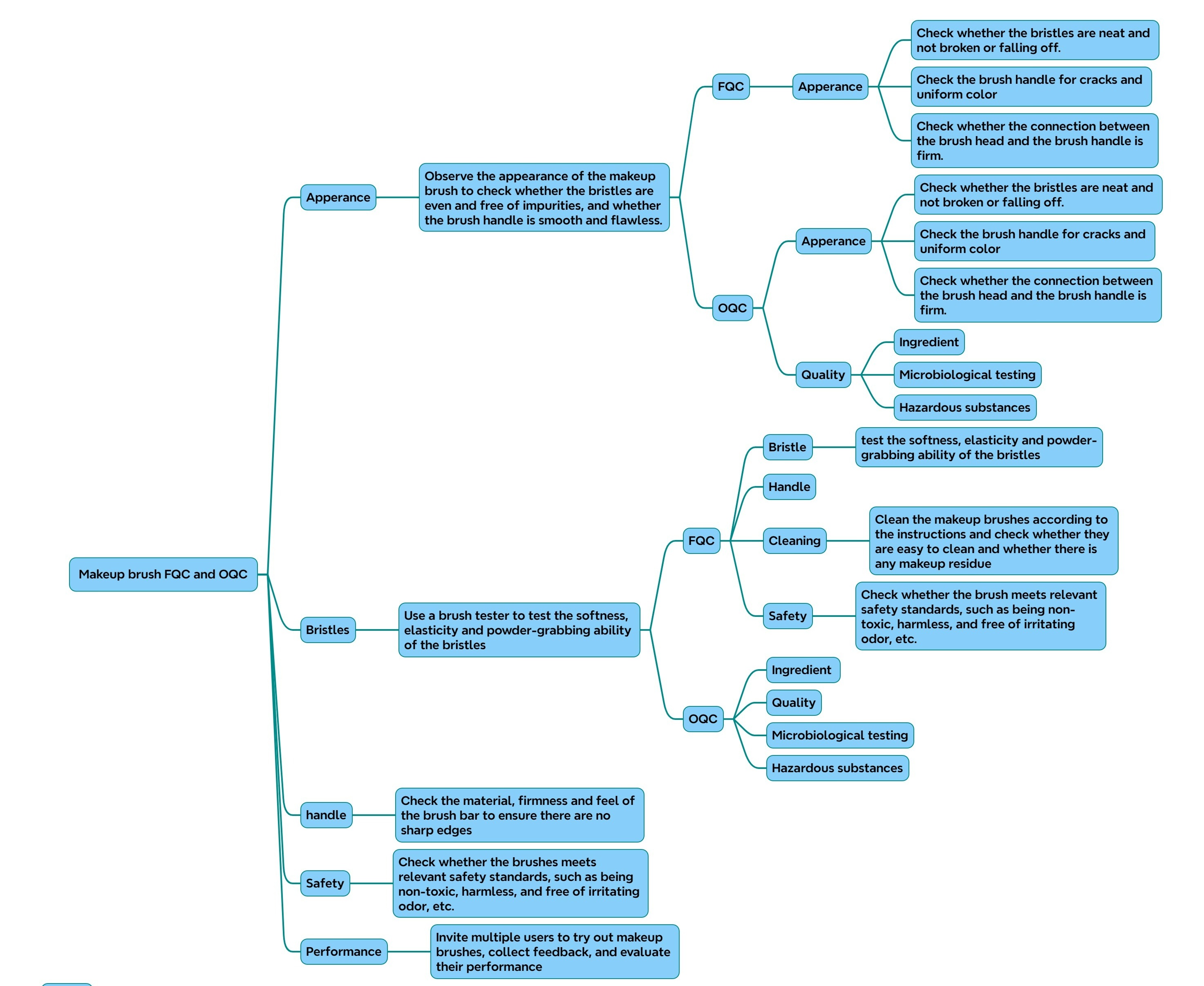
The FQC and OQC of makeup brushes

 The FQC (final quality control) and OQC (outgoing quality control) inspection items for makeup brushes can be summarized as follows:

 
FQC
 
Appearance inspection
  1. Bristles:bristle arrangement, uniformity, purities or breaks, color consistency
  2. Brush handle: surface smoothness, no sharp edges or flaws.
  3. No glue residue, clear logo printing.
  4. Tools: LED magnifier (20 times), colorimeter (ΔE<1.5).
 
Functional test
  1. Hair loss rate: brush 50 times on clean white paper, ≤3 hairs lost.
  2. Elastic recovery: The bristles recover more than 90% of their original shape within 1 second after being flattened.
  3. Powder pickup capacity: dip in calibration powder (such as talcum powder), weigh and compare the difference before and after dipping (need ≥0.5g).
 
Dimension and structure
  1. Dimensional tolerances of brush handle length, diameter, etc.;
  2. Connection firmness between brush head and brush handle (through pull-out force test).
 
Safety testing
  1. Chemical safety: tested by a third party for heavy metals (lead, arsenic, etc.) and phthalates (compliant with EU REACH regulations).
  2. Physical safety: sharp edge test (Rohs standard), bristle tip passivation (bristle tip curvature radius under a microscope > 0.1mm).
 
Packaging
  1. Inner packaging: dust bag/box sealing, moisture-proof agent (humidity <30%), no printing errors.
  2. Outer packaging: color box compression test (bearing 50kg without deformation), barcode scan rate 100%.
 
2. OQC inspection

Packaging integrity
The outer box is intact, the inner packaging is sealed and the accessories are complete (such as dust bags, instructions, etc.).

Batch sampling
Sampling according to AQL standards, focusing on expired products in stock (if more than 3 months, stricter inspection is required).

Document
Check whether the shipping documents (such as quality inspection reports, compliance certificates, packing lists) are complete.

Labels and compliance
The outer box label information (such as batch number, production date) is consistent with the order;
Comply with target market regulations (such as FDA, REACH, etc.).

Function retesting
Randomly sample and retest key performance (such as powder grabbing ability, safety).
 
3. Differences of FQC and OQC
  1. FQC focuses on quality control at the end of the production process and must cover all types of product defects;
  2. OQC focuses on risk control before shipment, focusing on quality problems that may arise during packaging, documents and inventory;
 
 
Batch management: Keep 5-10 samples per batch and keep them for 1 year for future reference.
 
Through the above process, the yield rate of makeup brushes can be effectively controlled (target ≥98.5%), while meeting the stringent requirements of high-end customers (such as professional makeup brands).

 
Kingyin is a professional Chinese makeup brush factory, with more than 15 years experience in makeup brush production and custom makeup brushes & OEM makeup brushes for worldwide customers and brands.
 
Kingyin has passed ISO9001, ISO14001, GMP,C-TPAT, FDA/ISO22716, BSCI and SEDEX/SMETA factory audit; with standard workshop, strict quality control and management system,which can ensure makeup brush production and quality.

2025年2月19日星期三

IPQC in makeup brush QC process

 In the QC process of makeup brush manufacturers, IPQC (In-Process Quality Control) is the core part in ensuring quality, controlling costs and maintaining brand reputation during the production process of makeup brushes.


 IPQC overall process


Pre-production preparation
  1. Check the production plan and bill of materials (BOM) to confirm that the bristles, ferrules, handles and other materials meet the specifications.
  2. Confirm that the equipment parameters (such as tube pressing machine pressure, glue amount, baking temperature) are consistent with the process documents (SOP/SIP).
  3. Check that the production environment (temperature, humidity, electrostatic protection) meets the requirements.

First piece inspection
  1. First inspection of key processes: such as brush head shape after pressing tube, glue dispensing amount, LOGO printing position, handle vertical etc., need to be confirmed to match the sample.
  2. Three-inspection system: worker self-inspection → team leader re-inspection → IPQC special inspection, stamp and release after passing.

On-Site Inspection

Frequency: 5-10 samples of key processes (such as head shaping, gluing, and hair trimming) are randomly inspected every 2 hours.
  1. Operational standardization (such as whether the brush head is cleaned thoroughly and whether the hair trimming is done to remove the stray hair).
  2. Equipment inspection (soldering iron temperature, electric screwdriver torque).
  3. Material consistency (hair material, handle color match the order).

Defects
  1. Identify and isolate defective products (such as split hairs, glue overflow), and trace the same batch of products.
  2. Trigger abnormal process: When the defective rate exceeds 3%, issue a "Quality Abnormality Form" and require the engineering department to analyze and improve.

Final piece inspection and record
  1. At the end of production, spot check the final piece to ensure that the entire batch of products has no batch defects.
  2. Organize inspection records, first inspection reports, and defect statistics tables, and archive them for traceability.


Specific control points:

Brush head production process
  1. Hair shaping: Manual shaping makeup brush head through special molds (cup) to ensure that the hair head has uniform curvature and clear layers;
  2. Trimming and shaping: Use mold to ensure that the hair head shape is consistent, without stray hair or split ends.
  3. Wire wrapping : Tie the hair head according to the brush type to prevent loose hair; after thread removal, the hair shape needs to be trimmed again.
  4. Removing loose hair: Remove loose hair scraps through centrifuge or manual combing to avoid later bristle falling.

Assembly and gluing
  1. Angle and symmetry: The angle tolerance between the brush head and the brush handle is ≤2°. Symmetrical brushes (such as blush brushes) require visual inspection equipment to assist in calibration.
  2. Gluing: The amount of glue used must be accurate (such as 0.07-0.53g/piece), and the glue gun temperature must be controlled at 120-150℃ to prevent overflow or degumming.
  3. Baking: The setting temperature is 80℃±5℃ for 12 hours to avoid deformation of the brush head.
  4. Connecting: After assemble the brush head and the handle, rotate 360° to check if any problem such as tilted head or gaps, and wipe off excess glue.
  5. Glue strength: When glue connecting the brush head and the ferrule, the glue (epoxy resin or environmentally friendly glue) must pass the tensile test (such as ≥5kg tensile force without falling off).

Cleaning and disinfection
  1. Dust removal and cleaning: The brush head needs to be ultrasonically cleaned to remove dust and broken hair, and the amount of residual hair is ≤0.1%.
  2. Disinfection: For animal hair, use ultraviolet light or ozone disinfection to ensure microbial indicators (such as total colony count <100CFU/g).


Surface and packaging

  1. Printing: LOGO printing must be clear , and must pass 5 tape peeling tests to ensure no fading; the position and clarity of the inkjet coding must be consistent with the sample.
  2. Surface treatment: Check whether the polishing is smooth and burr-free, and whether the paint/electroplating layer is uniform and free of bubbles.
  3. Appearance: fully inspect the bristle firmness, handle scratches and other appearance issues before packaging.

 Common problems and solutions
  1. Hair loss: Adjust glue gun pressure, refill glue and extend curing time
  2. Hair head deformation : Add shape-fix and drying process
  3. Brush head crook: Recalibrate cup mold and add head shaping process
  4. Brush handle broken: Replace to tough material and strengthen injection temperature control
  5. Handle painting peeling: Extend drying time and control workshop humidity ≤60%
  6. Printing blurred: Use UV curing ink or increase surface treatment


Kingyin is a professional Chinese makeup brush factory, with more than 15 years experience in makeup brush production and custom makeup brushes & OEM makeup brushes for worldwide customers and brands.

Kingyin has passed ISO9001, ISO14001, GMP,C-TPAT, FDA/ISO22716, BSCI and SEDEX/SMETA factory audit; with standard workshop, strict quality control and management system,which can ensure makeup brush production and quality.

2025年2月18日星期二

 Incoming material inspection is the core link of quality control in the production process of makeup brushes, and it is very important for makeup brush manufacturers to control the makeup brush quality as following:

 
1. Ensure the stability of raw material quality

Incoming material inspection avoids problems such as hair loss, breakage or discomfort in finished makeup brushes due to raw material defects by testing indicators such as bristle material (such as cleanliness, length, and toughness of animal hair or synthetic fiber), ferrule size accuracy (diameter tolerance within ±0.1mm), and wooden handle appearance defects (no scars or holes).

For example, when inspecting bristles, ensure no odor or impurities, and the bristle volume is controlled within the range of ±0.7g from 5g to 20g, and ±1.0g above 20g, which will directly affect the powder holding capacity and application effect of the makeup brush.

 
2. Reduce production costs and risks

By eliminating unqualified raw materials (such as ferrules with substandard glue content or brush heads with insufficient bristles), the waste caused by rework and scrapping during the production process can be reduce. If inferior bristles flow into the production line, it may cause customer complaints or product recalls, resulting in brand reputation and economic losses.

 
3. Ensure compliance and safety

Incoming material inspection needs to verify whether the raw materials comply with national quality inspection standards (such as GB/T 1.1-2020) and e-commerce platform requirements (such as CNAS/CMA certification reports). For example, test whether the glue ingredients contain harmful substances to avoid the risk of skin allergies. For export makeup brushes, they must also comply with international trade regulations (such as packaging labels, fumigation certificates, etc.).
 

4. Optimize supplier management

Inspection data can be used as a basis for supplier evaluation, high-quality suppliers can be screened out and their continuous improvement can be promoted.
For raw materials with frequent problems, suppliers can be required to provide rectification plans to improve the efficiency of supply chain collaboration.


5. Support standardization of production process

The incoming material inspection standard is closely linked to the subsequent process (such as glue amount ±0.05g, hair shape consistency ) to ensure each production process is controllable. For example, the ferrule diameter tolerance needs to be controlled within ±0.1mm, otherwise the brush head and handle may not match during assembly.

 
Incoming material inspection ensures the functionality and safety of makeup brushes from the source through multi-dimensional quality control (physical properties, chemical composition, appearance standards), while reducing the operational risks of the makeup brush factory.


The following is the standardized process and key quality standards for incoming inspection of makeup brushes
 
1. Inspection process
 
Preparation
  1. Check the purchase order with the "Bill of Materials" (including material description) provided by the supplier
  2. Prepare inspection tools: electronic scale (accuracy 0.1g), digital caliper (accuracy 0.01mm), colorimeter (ΔE≤1), 3M tape (test printing adhesion)
  3. Establish AQL sampling standards: usually use GB/T 2828.1-2012 II inspection level, CR=0, MA=0.65, MI=1.5
 
Appearance inspection (visual inspection)
  1. Lighting conditions: 1000±200Lux D65 standard light source;
  2. Inspection angle: 45° tilt observation, 360° rotation;
  3. Inspection frequency: first piece + 5pcs per hour
 
Dimension measurement
  1. Use non-contact image measuring instrument to detect key dimensions:
  2. Bristle length tolerance ±0.3mm
  3. Ferrule diameter deviation ≤±0.1mm
  4. Brush handle concentricity ≤0.15mm
 
Functional test
  1. Hair fall rate test: 500g weight hangs the bristles, ≤3 hairs fall off within 10 seconds
  2. Elastic recovery test: compress the bristles to 50% of the original length, and the recovery rate after release is ≥95%
 
Chemical safety testing
  1. Heavy metal migration test (lead ≤ 10ppm, cadmium ≤ 0.5ppm)
  2. pH test range: 5.5-8.5 (eye brushes need to be ≤ 7.5)
 
 
2. Key quality standards
 
Bristles
  1. Natural hair: SC animal quarantine certificate is required, hair scale integrity ≥ 90%
  2. Synthetic fiber: single filament diameter 0.08-0.15mm, cross-section must present a petal-shaped structure
  3. Planting density: ≥ 120 /cm² (foundation brush), ≥ 80 /cm² ( powder brush)
 
Ferrules
  1. Copper and aluminum pipes: thickness ≥ 0.3mm, no rust after 72h salt spray test
  2. Electroplating layer thickness: nickel layer ≥ 5μm, chromium layer ≥ 0.3μm
 
Wooden handles
  1. Moisture content: 8%-12%, FSC certification required
  2. Coating adhesion: 100-grid test: 3M tape peeling off area ≤5% after tearing
  1. Thickness of a single brush head protective cover ≥ 0.15mm PET material
  2. Color box edge ≤ 0.5mm, color difference ΔE ≤ 1.5
 
3. Defective products
 
  1. For critical defects (such as slight color difference), the deviation is allowed to be within 2%
  2. For major defects (such as loose structure), the whole batch will be detained and the 8D reporting process will be initiated
  3. Batches with excessive microorganisms need to be sterilized by EO (residual amount ≤ 10μg/g)
 
Note: All test data must be uploaded to the QMS system, and the original records must be retained for at least 3 years.Conduct laboratory comparison tests every quarter to ensure that the error rate of the testing equipment is ≤1.5%. For new environmentally friendly materials (such as bamboo fiber), a supplementary testing plan should be established.

2025年2月17日星期一

 Makeup brush manufacturers that mainly serve European and American customers face multiple challenges in the current trade environment and market competition (such as tariff barriers, upgraded compliance requirements, changes in consumer preferences, etc.), but there are also opportunities to consolidate their market position through strategic adjustments. The following are targeted solutions for such makeup brush factories:

 
1. Dealing with the core challenges of the European and American market
 
Breaking through tariffs and trade barriers

  1. Transferring production bases: Setting up branches in Southeast Asia (Vietnam, Cambodia) or Eastern Europe (such as Poland and Turkey), and taking advantage of local tariff preferences for exports to Europe and the United States.
  2. Semi-finished makeup brushes + local assembly” model: Exporting semi-finished makeup brushes to Mexico or Eastern Europe, and completing final assembly locally to circumvent the restrictions of US rules of origin.
  3. Applying for tariff exemptions: Striving for exemptions from the US “Section 301” for specific products (such as makeup brushes made of environmentally friendly materials).
 
Strengthening compliance and certification
  1. European and American regulatory priorities: Ensure that makeup brushes pass mandatory certifications such as EU REACH (chemical safety), US FDA (direct skin contact certification), and CFDA (China’s new version of cosmetics regulations).
  2. Ethical and environmental labels: Obtain labels such as Vegan, Cruelty-Free, and FSC (Sustainable Forest Certification) to meet the value needs of European and American consumers.
 
2. Accurately match the needs of the European and American markets

Product strategy upgrade
 
  1. High-end and professional: Launch customized makeup brushes (such as antibacterial bristles, ergonomic handles), brush sets (such as the "Environmentally Friendly Artist Series") for professional makeup artists and makeup enthusiasts in Europe and the United States.
  2. Segmented scene needs: Develop synthetic fiber brushes for sensitive skin, high-reflective shooting brushes for YouTube bloggers, etc.
  3. Sustainable innovation: Use recycled aluminum brush handles, bio-based nylon bristles, and even launch a "replaceable brush head" design to cater to the circular economy trend.
 
Optimize localized services
 
  1. Quick response for small orders: Establish local warehouses in Europe/USA to support 48-hour delivery of small batch orders (such as through Amazon FBA or cooperation with ShipBob).
  2. Design close to European and American aesthetics: Set up design centers in Europe and the United States or cooperate with local designers to avoid cultural barriers (such as Europe and the United States prefer matte metallic colors rather than Chinese style).
  3. Provide value-added services: Develop teaching videos and social media material packages (such as TikTok short video templates) for brand customers to reduce customer marketing costs.
 
3. Reconstructing the supply chain and cost structure

Building supply chain resilience
 
  1. Dual-source procurement: Key raw materials (such as high-quality goat hair and synthetic fibers) are purchased from both Chinese and European suppliers to reduce the risk of supply interruption.
  2. Digital supply chain management: Introducing ERP and IoT technologies to track European and American inventory and order dynamics in real time to avoid unsalable or out-of-stock products.
 
Cost optimization path
 
  1. Automation replaces manual labor: Introduce AI quality inspection equipment (such as visual recognition and sorting of defective bristles) and robotic arm assembly lines to offset the labor cost advantage in Southeast Asia.
  2. Light asset overseas: Cooperate with overseas local OEM factories (such as Italian brush workshops) to reduce the risk of heavy asset investment through the "technology authorization + quality control output" model.
 
4. Transformation from OEM to branding

OEM/ODM upgrade strategy
 
  1. Binding with top brands: providing exclusive design + production services for high-end brands in Europe and the United States (such as Sigma, Morphe), and establishing long-term cooperative relationships.
  2. "White label + private label" in parallel: incubating private brands while OEM, focusing on the DTC (direct to consumer) model in the early stage.
 
Brand marketing breakthrough
 
  1. Social media : Cooperating with European and American beauty KOLs on Instagram and YouTube, emphasizing "professional makeup tools" and environmental protection concepts.
  2. Crowdfunding platform verification market: launching limited editions through Kickstarter, testing product popularity and accumulating seed users.
  3. Offline channel penetration: entering chain stores such as Ulta Beauty and Sephora, or cooperating with European and American professional beauty academies.
 
5. Make use of policies and ecological resources

Use of policy dividends
  1. Cross-border e-commerce policies: Obtain traffic support through Alibaba International Station and Amazon Brand Accelerator Program.
  2. Regional Free Trade Agreement: Use the RCEP framework to import raw materials from ASEAN and export them to Europe and the United States to reduce overall costs.
 
Ecosystem cooperation
  1. Cross-border collaboration: Collaborate with European and American artists and environmental organizations (such as the "Ocean Protection Series") to increase brand premium.
  2. Join industry alliances: Participate in the international zero-cruelty organization (Leaping Bunny) or sustainable beauty initiatives to enhance credibility.
 
6. Long-term risk management
  1. Market diversification: gradually explore alternative markets such as Central and Eastern Europe (Poland, Czech Republic) and Latin America (Mexico, Brazil) to reduce dependence on a single region.
  2. Legal risk plan: hire local compliance consultants in Europe and the United States to respond to potential anti-dumping investigations or intellectual property disputes in advance.
 
Chinese makeup brush factories with Europe and the United States as their core markets need to shift from "cost-driven OEMs" to "value-driven service providers" and build global risk resistance capabilities while maintaining the European and American base through compliance upgrades, product innovation, supply chain resilience, and brand penetration. The key lies in:
 
Close to customer needs (such as environmental protection, fast delivery);

Technology-enabled costs (automation + digitalization);

Branding premium (upgrade from tool supplier to beauty solution provider).

2025年2月16日星期日

 In the context of the Sino-US trade war, Chinese makeup brush factories are facing multiple challenges such as tariff pressure, supply chain adjustments, and changes in market demand, but there are also new opportunities. The following are possible solutions and layout strategies for Chinese makeup brush factories:

 
1. For direct challenges of the trade war
 
Tariff cost transfer and optimization
a. Reduce dependence on exports to the United States through supply chain diversification, such as setting up factories in Southeast Asia (Vietnam, Indonesia, etc.) and taking advantage of local low tariff policies to export to the United States.
b. Negotiate with customers to share tariff costs, or improve bargaining power through product upgrades (high value-added products).
c. Optimize logistics routes and choose intermediate countries that are not subject to tariffs.
 
In compliance and certifications
Strengthen compliance with international regulations (such as the US FDA, EU REACH, etc.) to ensure that makeup brushes meet environmental protection, animal protection (such as no animal testing certification) and other requirements to enter the high-end markets in Europe and the United States.
 
 
2. Diversified market layout
 
Explore emerging markets
a. Southeast Asian market: With the rise of local beauty consumption, affordable makeup brushes can be launched for countries such as Indonesia, Thailand, and the Philippines.
b. Middle East market: Design luxury makeup brushes to meet the needs of Middle Eastern women for high-end makeup tools.
c. African market: Cover the rapidly growing middle class through cross-border e-commerce (such as Jumia).
 
Deepen the domestic market
a. Seize the dividends of China's "national fashion beauty" and launch localized designs (such as IP joint names, national style packaging).
b. Directly reach consumers through live e-commerce (TikTok, Kuaishou) and social e-commerce (Xiaohongshu) to create private brands.
 

3. Technology upgrade and product innovation
 
Intelligent manufacturing and automation
a. Introduce automated production equipment (such as AI sorting, 3D printing molds) to reduce labor costs and improve efficiency.
b. Apply digital management tools to optimize inventory and supply chain response speed.
 
Material and functional innovation
a. Develop environmentally friendly materials (such as plant fiber bristles, degradable packaging) to cater to the international sustainable consumption trend.
b. Introduce functional products (such as antibacterial bristles, modular brush handles) for sensitive skin, professional makeup artists and other segments.
 
Cross-border cooperation and brand premium
a. Join hands with international beauty brands and designers to enhance brand value.
b. Enhance user stickiness through the "tool + content" model (such as matching makeup tutorials).


4.  Supply chain and value chain reconstruction
 
Vertical integration and localized production
a. Extend upstream, control the supply of key raw materials (such as high-quality animal hair and synthetic fibers), and reduce the risk of cost fluctuations.
b. Establish regional central warehouses around the target market to shorten the delivery cycle (such as European warehouses and Latin American warehouses).
 
Flexible supply chain system
a. Adopt the "small order fast response" model to adapt to cross-border e-commerce and personalized customization needs.
b. Use big data to predict market trends and dynamically adjust production capacity.
 

5. Long-term strategy: branding and globalization
 
Shift from OEM/ODM to OBM
a. Gradually reduce reliance on OEM and occupy the mid-to-high-end market by incubating own brands.
b. Build a global brand image through independent websites and overseas social media (Instagram, TikTok etc).
 
Invest in R&D and design
a. Establish overseas design centers (such as Paris and Seoul) to absorb international trends.
b. Apply for patented technologies (such as antibacterial brush technology) to build technical barriers.


6. Risk hedging and policy leverage
 
Use policy support
a. Focus on China's "dual circulation" policy, apply for special funds for foreign trade transformation and upgrading, and policy dividends for cross-border e-commerce comprehensive pilot zones.
b. Participate in regional cooperation under the framework of RCEP (Regional Comprehensive Economic Partnership Agreement) to reduce tariff costs.
 
Financial instrument hedging
a. Hedge exchange rate fluctuation risks through foreign exchange futures and forward contracts.
b. Use export credit insurance to reduce overseas accounts receivable risks.


The Sino-US trade war is both a challenge and a catalyst. Chinese makeup brush factories need to shift from low-cost manufacturing to high-value creation, gradually get rid of their dependence on a single market through market diversification, technology upgrades, branding and supply chain resilience, and take a more active position in the global beauty tool industry chain.

2025年2月13日星期四

What is the standard of a good makeup brush OEM factory?

 A good makeup brush OEM factory needs to meet a series of strict standards to ensure the high quality, safety and market competitiveness of the makeup brushes. The following are the key criteria for evaluating a makeup brush OEM factory:


1. Raw material standards

Bristle quality:

Natural hair (goat hair, pony hair,sable hair etc.) must pass the tests of flexibility, elasticity, powder pickup capacity, and ensure no impurities and damage.

Synthetic hair (nylon, PET, etc.) must have a delicate touch, high resilience and high temperature resistance.

Bristle source: Traceable supplier qualifications must be provided, to prove cruelty free.

Hair processing technology:Hair scale repair, anti-allergic treatment (such as acid neutralization process), antibacterial coating technology (reduce the risk of allergy).

Brush handle and accessories:

Wooden handle: must be treated with mildew and moisture-proof, and the wood must comply with FSC environmental certification.

Metal parts: Aluminum ferrules must be electroplated for rust prevention, and plastic parts must comply with RoHS environmental standards.

Glue: Use non-toxic and environmentally friendly glue and pass VOC (volatile organic compound) testing.

2. Production process standards

Manual process:

Manual hair trimming must ensure that the hair peaks are aligned and uneven, and the hair density is uniform (such as Japan's "three-point positioning" process).

The brush head fits tightly with the ferrule without glue overflow.

Automatic process:

The CNC hair cutting machine accurately controls the hair length (within ±0.5mm tolerance).

The injected handle accuracy reaches ±0.02mm to avoid ferrule deformation.


3. Quality control system

IQC (Incoming Quality Control): bristle moisture content, diameter test, metal parts salt spray test.

IPQC (In Process Quality Control): spot check brush head firmness (tensile test ≥5kg), and hair peak integrity.

FQC (Final Quality Control): full inspection of brush assembly, hair fall rate (≤1 piece/10,000 simulated uses).

Chemical safety: passed EU REACH and US FDA standards, no heavy metals (lead, cadmium, etc.).

Physical safety: bristle tip passivation treatment (to prevent eye scratches), neutral pH value (6.5-7.5).


4. Certification and Compliance

ISO 9001 (quality management), ISO 22716 (GMP for cosmetics), BSCI (social responsibility).

Provide complete COA (Certificate of Analysis), MSDS (Material Safety Data Sheet).


5. Customized service capabilities

Support small batch orders (such as MOQ 500 pieces), provide mixed bristles options (such as goat hair mixed synthetic hair).

Packaging customization: from hot stamping LOGO to environmentally friendly and degradable materials (such as bamboo boxes, soy ink printing).

Sign an NDA agreement to ensure that the customer's design patent is not leaked.


6. Supply Chain and Delivery

Regular orders lead time ≤60 days, urgent orders ≤30 days (expedited charges must be specified).

Safety stock (such as standard brush handles, standard hair materials) to meet urgent orders.  


7. Social responsibility

Comply with ILO standards, provide salary flow and working time records for reference.


Additional suggestions

On-site factory inspection: checking the cleanliness of the injection molding workshop and the quality inspection laboratory equipment (such as microscopes and tensile testing machines).

Trial order process: require the makeup factory to provide free samples to test the actual performance.

Makeup brush OEM factories that meet the above standards can provide brands with high value-added makeup brushes while reducing market risks and helping brands quickly establish reputation.


Important Notes:

Good makeup brush manufacturers often have a 2-3 month lead time, so it is recommended to start the screening process 6 months in advance. For the first cooperation, a third-party inspection (such as SGS) must be conducted before shipment to reduce the quality risk. For long-term cooperation, a VMI (vendor managed inventory) model can be negotiated to optimize supply chain efficiency.